Sunday, August 20

1.4.15 Explain how errors in DNA replication can give rise to mutations and explain how cystic fibrosis results from one of a number of possible gene mutations.


Mutation: during DNA replication/ transcription/ translation (any stage when the genetic code is copied) a mistake can be made in the new base sequence formed. This changes the base sequence on the DNA, which can give rise to a change in amino acid sequence in the protein, in turn, this changes the protein structure, affecting the formation of the correct protein.


Mutations that occur during DNA replication can have the greatest effect because they are passed to new cells: in body cells they may lead to cancer, in gametes they can be passed to offspring and lead to genetic disorders such as cystic fibrosis. 

1.4.14 Outline the process of protein synthesis, including the role of transcription, translation, messenger RNA, transfer RNA and the template (antisense) DNA strand (details of the mechanism of protein synthesis on ribosomes are not required at IAS).

Transcription
- The DNA unwinds as hydrogen bonds between base pairs split to separate the two strands.
- The antisense strand is used as a template; the RNA nucleotides attach this strand as they pair with their complement on the template stand, forming mRNA.

Translation 
- The mRNA moves out of the nucleus and attaches it self to the ribosome in the cytoplasm. 
- The tRNA has an amino acid binding site, which allows it to attach to a specific amino acid and carries it to the mRNA in the  ribosome, where the amino acid joins to others carried by other tRNA to build a polypeptide. 


1.4.13 Describe a gene as being a sequence of bases on a DNA molecule coding for a sequence of amino acids in a polypeptide chain.


- A gene is a sequence of bases on one of the strands of a DNA double helix molecule which codes for a chain of amino acids ( i.e. codes for a polypeptide chain).


1.4.12 Explain the nature of the genetic code (triplet code only; non-overlapping and degenerate not required at IAS).

- Τhe genetic code is the order of bases on one strand of DNA, this code is formed from triplets of bases, 
each triplet codes for an amino acid.
- Α sequence of triplets codes for the sequence of amnio acids that’ll form a polypeptide, which will fold up to form a protein. 

1.4.11 Describe DNA replication (including the role of DNA polymerase), and explain how Meselson and Stahl’s classic experiment provided new data that supported the accepted theory of replication of DNA and refuted competing theories.


Replication 
- The two strands of DNA unwind and split apart.
- The exposed bases attract the the free DNA nucleotides, they line up along each strand, observing the complementary bases pairing rules. 
- The enzyme DNA polymerase bonds the nucleotides together, forming a phosphodiester bond between each deoxyribose and a adjacent phosphate group. hydrogen bonding link the two strands together.

Meselson and Stahl's Classic Experiment
- A sample of bacteria was grown in a nutrient broth containing light nitrogen, and one on a broth with heavy nitrogen, as bacteria reproduced they took up nitrogen so it became a part of their DNA.
- A sample of DNA was taken from each batch of bacteria and spun in a centrifuge: the DNA from the heavy nitrogen bacteria settled lower down in the centrifuge tube than the DNA from the light nitrogen bacteria. 
- The bacteria grown in heavy nitrogen broth were taken out and put in a broth containing only light nitrogen.
- After one round of DNA replication another DNA sample was taken and spun in the centrifuge, it settled in the middle, showing that the new bacterial DNA molecule contained one strand of the heavy nitrogen and one strand of the light nitrogen; the bacterial DNA had replicated semi conservatively.

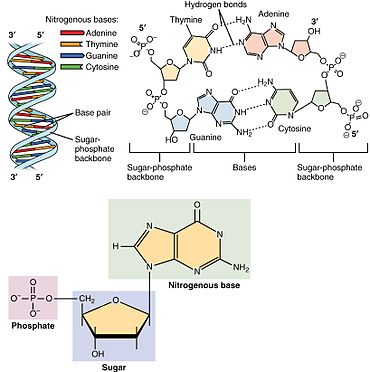
1.4.10 Describe the basic structure of mononucleotides (as a deoxyribose or ribose linked to a phosphate and a base, i.e. thymine, uracil, cytosine, adenine or guanine) and the structures of DNA and RNA (as polynucleotides composed of mononucleotides linked through condensation reactions) and describe how complementary base pairing and the hydrogen bonding between two complementary strands are involved in the formation of the DNA double helix.


- Nucleotides contain a phosphate group, a base ( either a purine: adenine & guanine or a  pyrimidine: thymine, uracil and cytosine), and a pentose sugar (deoxyribose/ ribose) joined in a condensation reaction, the phosphate joins to carbon 5 of the sugar and the base joins to carbon one. 

- Nucleotides are joined in a condensation reaction between the sugar of one nucleotide and the phosphate group of the other nucleotide via phosphodiester bond.


- Many nucleotides join together to form single stands in RNA, complimentary base pairing allows hydrogen bonding between bases holding DNA in a double stranded structure, two H bonds form between A and T, three between C and G. 
Related image
Image result for nucleotides

1.4.9 Describe how enzyme concentrations can affect the rates of reactions and how this can be investigated practically by measuring the initial rate of reaction.


(the rate of reaction slows down as substrate is used up)

Procedure:

  • prepare a range of enzyme concentrations, at least five
  • pipette 5cm3 of protein suspension (egg albumin or milk) into 5 test tubes. 
  • substrate concentration (protein suspension) should not be limiting at the start of the experiment.
  • mix the enzyme and the substate thoroughly and immediately start the stopwatch. 
  • measure the dependent variable by measuring the time taken for the protein solution to clear at each of the enzyme concentrations. 
  • temperature should be kept constant by using a water bath maintained at 30 degrees and the pH maintained constant using a buffer solution.
  • repeat the experiment at each enzyme concentration and find the average.